
This phase establishes the critical foundation for your entire implementation. You'll work closely with the Findhelp team to define your program's vision, goals, and scope, ensuring everyone is aligned on the expected outcomes. Our objectives are:
- Secure Stakeholder Alignment: Ensure all key stakeholders are prepared to make timely and informed decisions so your organization can fully realize the value of the platform.
- Define Team Structure: Confirm your governance structure and clearly define the roles, responsibilities, and expectations for everyone involved. This drives effective communication and streamlines all processes.
- Establish the Program Vision: Collaborate with the Findhelp team to create a shared program vision and confirm the specific focus areas that will guide your project.
Support Through Implementation and Evolving Your Program
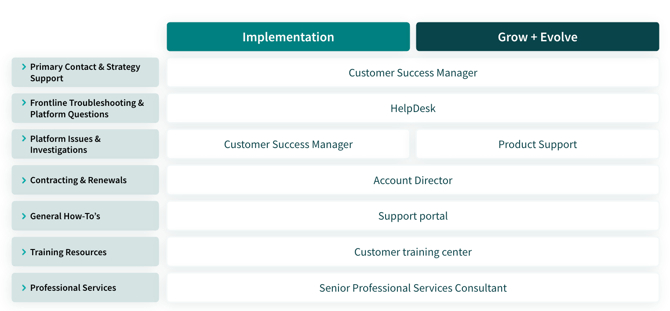
You won't be navigating this alone. The Findhelp team is committed to supporting you across all implementation phases. Our specialized departments will proactively reach out during key stages of your journey. The chart below shows when you can expect each team to reach out.
Initiate + Align Phase
Ahead of your first Findhelp implementation project call, you will receive a project plan template. We have a few things we need you to fill out that are outlined below. This will let your first call set the pace for your program implementation.
1. Defining Your Key Roles
Define who from your organization should be assigned to each role. The main responsibilities are outlined in the chart below. Add who you think should fill that role in the Charter, Vision, + Key Roles tab in your project plan.
|
Key Roles |
Responsibilities & Time Commitment |
|
Executive Sponsor |
Time Commitment: During Implementation (.1 FTE) Post Implementation (.05 FTE) |
|
Program Manager |
Time Commitment: During Implementation (.2 FTE) Post Implementation (.1 FTE) |
|
Operational Leaders |
Time Commitment: During Implementation (.6 FTE) Post Implementation (.4 FTE) |
|
Training Lead |
Time Commitment: During Implementation (6 FTE) Post Implementation (.4 FTE) |
|
Marketing Lead |
Time Commitment: During Implementation (.2 FTE) Post Implementation (.1 FTE) |
|
Community Lead |
This is describe the role of a Community Lead under a “self-service” approach to community engagement. Findhelp can provide additional support through our professional service packages.
Time Commitment: During Implementation (.6 FTE) Post Implementation (.4 FTE) |
2. Building Your Charter
Your charter will define your social care program vision, objectives, roles and goals to ensure alignment across stakeholders. It will live in your Project Plan.
|
Social Needs Screening and Referral Integration |
|||
|
Vision Statement |
Example: Develop a closed-loop referral ecosystem with professional navigators referring seekers to trusted network partners and measuring outcomes for your seeker population. |
||
|
Program Objectives |
|||
|
Seeker Engagement |
|
||
|
Professional Navigators |
|
||
|
Community Partnerships & Referral Pathways |
|
||
|
Navigator Education & Change Management |
|
||
|
Program Scope |
|||
|
Target Population |
|
||
|
Professional Navigators |
|
||
|
System of Record Integration |
|
||
3. Defining Your Vision
The Findhelp platform is a dynamic, comprehensive tool built on the nation's largest network of free and low-cost social care services.
It helps you manage every step of the social care process:
- Screening and Resource Discovery
- Referrals and Progress Tracking
- Payment Facilitation and Impact Assessment
Because your Findhelp platform is flexible, you must clearly define how you plan to use it to achieve your desired outcomes. A clear vision acts as a roadmap, ensuring everyone on your team is aligned and focused on the same definition of success.
As your program's complexity and goals increase, the resources and effort needed to realize those goals will increase across four key areas:
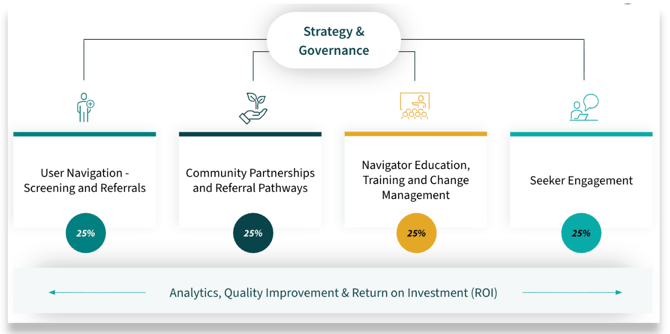
- User Navigation - User Screening and Referral Workflows - where you will identify core users and required workflows to facilitate efficient acquisition and delivery of services to meet the needs of your population
- Seeker Engagement - where you will define the core architecture and features of your tailored solution, while securing stakeholder understanding and enthusiasm for its proposed design and capabilities
- Community Partnerships & Referral Pathways - where stakeholders will learn about about network approach, curation pathways, partnership models, and scope community investment strategy to achieve desired outcomes
- Education & Change Management - where you will develop a sustainable ongoing training and change management strategy to ensure end user adoption and engagement with your platform
- Analytics + ROI- where you will determine which reports are important based on goals and workflows, and develop a strategy to achieve ROI for your organization.
Defining Your Social Care Goals: Two Main Paths
The resources you invest and the outcomes you measure depend entirely on your program's goals. Generally, customers follow one of two paths:
Path 1: Focus on Public Self-Service
In this scenario, your main goal is to help individuals (seekers) find resources on their own by anonymously searching the platform. You do not currently have professional staff, like Community Health Workers, dedicated to navigating social care on behalf of seekers.
Because of this focus, your highest investment will be in Seeker Engagement. This means objectives like developing a robust marketing and promotion campaign to spread platform awareness. Conversely, you won't invest heavily in training specialized staff or establishing formal community partnerships. Your success will be measured using process metrics such as platform users, searches, and interactions—not closed-loop referrals.
Path 2: Focus on Professional Navigation and Closed-Loop Referrals
Alternatively, your goal may be to build a closed-loop referral ecosystem where professional staff (such as Care Managers) actively navigate and refer seekers to trusted community organizations (CBOs). These partnerships allow you to track the referral process through to a successful outcome.
While you'll still focus on seeker engagement, your resource investment will be highest in training professional navigators, establishing formal community partnerships, and providing workforce education. By achieving closed-loop outcomes, you can measure real results and impact on your entire seeker population.
What Comes Next
Scheduling Your Implementation Project Meetings
- Weekly Project Meeting: Schedule a recurring 30-minute weekly sync with your Findhelp support team and Customer Program Manager to manage day-to-day activities and tasks.
- Monthly Executive Meeting: Schedule a recurring 30-minute monthly sync with your Findhelp support team and your Executive Sponsor to review progress and major upcoming milestones.
- Kick off the Scope & Design Phase: Coordinate a kickoff meeting with all identified key stakeholders to officially begin the Scope and Design phase of your project.
Kicking off the Scope + Design Phase