
As the world of social care is maturing, Findhelp is committed to moving along with it to best support you and your operations. Customers adopt varying approaches to community impact in alignment with their vision and Social Care Program goals. When closed-loop referrals are identified as a goal, community parterships are not just a bonus - they're essential.
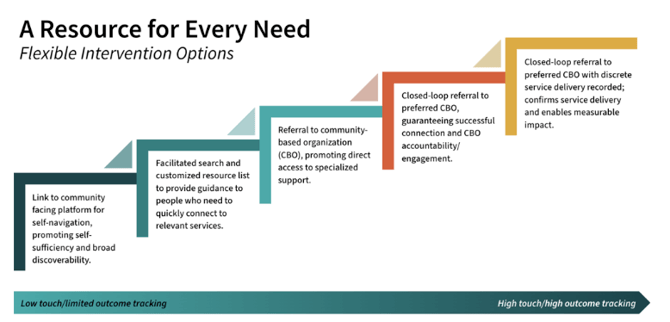
Community Engagement is the investment in community partnerships. In order to really extend the care outside of your organization, community partnerships are a necessary element.
Forming a Strategy
When forming your plans for investing in community partnerships, it is important to zoom out and assess the ecosystem of your approach to social care. Through the formation of your own health equity / population health / Social Determinants of Health (SDoH) strategy, you have likely identified many key areas that will inform your strategy (ex. target population, primary needs, and key user groups).
Defining each of these components with your team is a helpful exercise to ensure alignment in your internal (staff) and external (community) approach to platform adoption. This groundwork will help you develop a strategic and integrated approach in your engagement of community community organizations . Ultimately, this translates to greater project success and a more sustainable social care strategy.
Once you have a good understanding of the key groundwork components that will inform your community engagement, the work can start to take form. We have developed this learning hub as a way to walk you through our recommended process with access to resources and materials. No matter your goals or your starting point, this phased approach can be adapted to meet the needs of your organization.
The ultimate goal of this hub is to walk you through the internal process on how to establish and maintain community partnerships that are vital to your organization’s investments in social care.

To understand community engagement, it is necessary to understand key terms used in Social Care conversations and throughout this hub. The table below will be a helpful reference along the way.
Actions
1. Review the commonly used terms and acronyms table below.2. Gather your organization’s health equity / population health / SDoH strategy and document key components that will help inform your community engagement goals and work. These include:
- target population(s)
- primary need(s)
- key user group(s) --those who will be using your Findhelp site
- strategy timeline goals
3. Explore our self-guided support resources to build and manage a high-impact community engagement strategy at your own pace.
Commonly Used Terms/Acronyms
|
Term/Acronym |
Definition |
|---|---|
|
Community Engagement (CE) |
Community Engagement; The investment in community partnerships |
|
Community based organizations AKA: community organizations |
A public or private organization which provides mission-driven support services to individuals in the community. |
|
Program / Claimed Programs |
A program is a specific service offered by community organizations (e.g. Soup Kitchen at the Salvation Army). When a person(s) at the program/CBO claims their program in the Findhelp database, they have taken ownership of their listing and can now edit and update the listing, as well as access free intake tools and reporting to support their program. |
|
Community Impact Lead (CI Lead) |
Findhelp customer project team members who develop partnerships and engagement strategies to advance their social care vision and goals. |
|
Social Determinants of Health (SDoH) |
Our customers use many names for this term (social drivers, non-medical drivers, social influencers of health, etc). We will refer to SDoH, recognizing the many nuances and varied customer approaches to addressing social needs. |
|
Claimer |
Person who works at a Organization that can accept/review screeners, claim/update programs. When customer programs are listable, it can be a customer Worker with these permissions. |
|
Navigator AKA: Helper AKA: Referrer |
Person who assists people in need. Could be friend, nurse, social worker, case manager, etc. |
|
Person in Need AKA: Seeker |
A person looking for services. Depending on the vertical and type, a Organization can refer to a Person in Need as a client/patient/customer/member. |
|
Users |
Unique users; can include claimers, seekers, and/or customers. |
|
Connections |
Actions that reflect a connection between the seeker and a program. |
|
Open Network |
Findhelp’s online nationwide network of programs and community organizations |
|
Referrals / Referral Status / Closed-Loop Referrals |
Referrals are a function in the Findhelp search that sends information about the person to the program and makes a connection. Referrals can be made by a seeker or a Navigator, and the status of the referral can be shared and updated among Users who belong to the same Group. Seekers can also update their referral status. Closed Loop Referrals indicates that the referral has a conclusive status update (any status that is not “eligible”, “not yet helped”, “pending”, or “needs action”). |
|
Free Suite of Tools |
In a CE context, these tools refer to program management, intake tools (basic referrals, screener, scheduler) as well as analytics that community community organizations have access to when they claim their program(s). |
|
Trusted Network |
A customized subset of programs from the open network that have been selected and curated by a customer. |
|
Screener |
An eligibility form that enables community organizations to gather additional information from Seekers attempting to receive services |
Up Next
Review Outline your CE Investments to continue building your community partnership strategy.